

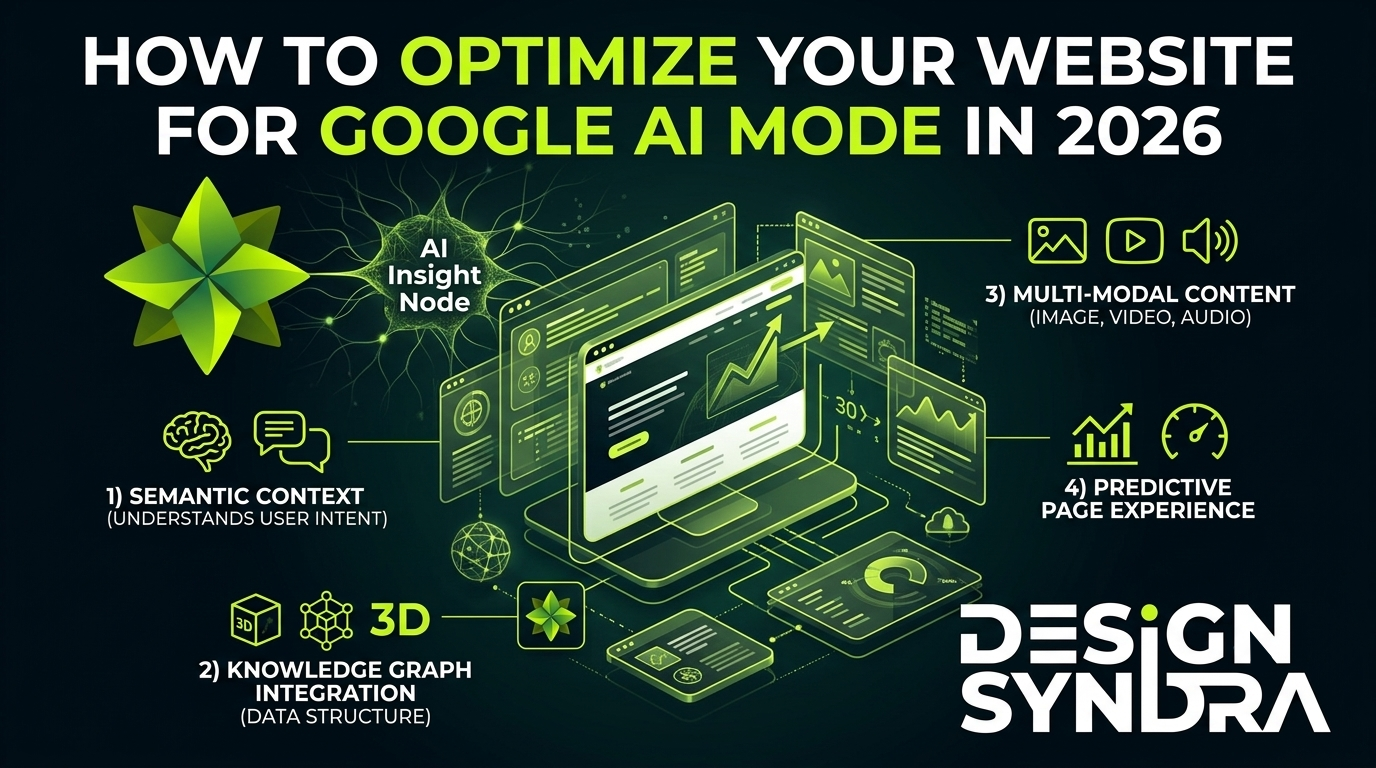
Why Optimizing Your Website for Google AI Mode Matters in 2026
Knowing that Google AI Mode is reshaping search is one thing. Knowing exactly what to change on your website because of it is another. Most of the advice circulating right now stops at “focus on quality content,” which is true but not actionable enough to move a business forward. This guide goes further. It walks through the specific, practical work involved in optimizing a website for Google's AI-powered search experience in 2026, from understanding how AI Mode actually selects sources, to the technical, content, and trust-building changes that genuinely improve your chances of being cited, recommended, and clicked.
Understanding Google AI Mode Before You Optimize for It
Google AI Mode is a conversational, Gemini-powered search experience that synthesizes answers across multiple sources rather than returning a simple list of ranked links. Google confirmed at its 2026 developer conference that AI Mode now runs on the Gemini 3.5 Flash model, supports multimodal input such as images and files, and is no longer an experimental feature but a core part of the Search experience. Optimizing for it effectively starts with understanding how it actually behaves, because the tactics that worked for ranking in a list of ten blue links do not automatically translate into being selected as a cited source inside an AI-generated response.
What Makes AI Mode Different From Traditional Search
Traditional search returns a ranked list and lets the user decide which result best answers their question. AI Mode does some of that evaluation on the user's behalf, pulling information from several sources into one synthesized answer and allowing the user to ask follow-up questions within the same session. This changes what “ranking well” actually accomplishes. A page that ranks third or fourth but is clearly written, well-sourced, and easy to extract facts from may get cited inside an AI Mode response more often than a page that ranks first but reads as generic or thin.
AI Mode vs. AI Overviews: Why the Distinction Matters for Your Strategy
AI Overviews appear automatically above standard results for many informational queries and are built for short, direct answers. AI Mode is a dedicated, opt-in interface for longer research sessions involving follow-up questions. This means the content that performs well in each context is not identical. A concise, clearly structured paragraph with a direct answer near the top of a page tends to get pulled into AI Overviews, while AI Mode rewards pages with enough depth, nuance, and supporting detail to sustain a multi-turn conversation. A strong AI-search strategy accounts for both rather than optimizing for just one.
Why Optimizing for AI Mode Has Become Non-Negotiable
Independent research from sources including Ahrefs, Search Engine Journal, and Pew Research has documented organic click-through rate declines of roughly 40 to 60 percent for top-ranking pages once an AI Overview appears above them, and a 2026 randomized field study found that removing AI Overviews nearly doubled outbound clicks for participants. Reporting using Graphite data found a more modest single-digit year-over-year decline in overall U.S. organic traffic, but the distribution of clicks has shifted noticeably, with research from ALM Corp showing organic click share down by double digits across several verticals.
Is Traditional SEO Dead? What This Shift Really Means for Website Ranking
No, but it has been redefined. SEO in 2026 is no longer just about earning a top-ten position; it now includes earning a citation inside an AI-generated answer and building enough brand recognition that users search for you by name rather than relying on a generic query. Some in the industry describe this as Answer Engine Optimization, but in practice it is an extension of long-standing SEO fundamentals rather than a separate discipline. The websites adapting successfully are not the ones discarding SEO; they are the ones reinforcing the parts of it that AI summaries cannot easily replicate, original expertise, demonstrable trust, and genuinely useful content.
Step 1: Build Content Around Genuine User Intent
Google's AI systems interpret the meaning and context behind a query, not just the keywords used. A page about “best accounting software for small business” that only lists product names, without addressing pricing tiers, integrations, or who each tool suits, leaves obvious gaps an AI system will fill in from a competitor's page instead. Map content to a single, clear intent (informational, commercial, transactional, or navigational) rather than trying to serve all four on one page; focused content is easier for AI systems to confidently match to a specific query.
Step 2: Strengthen Topical Authority With Content Clusters
A single well-optimized page rarely outperforms a website that has built comprehensive coverage of a subject over time. To build topical authority deliberately, start by mapping every realistic question your audience asks around your core subject areas, then organize that content into clusters: a pillar page covering the topic broadly, with supporting articles addressing specific subtopics, objections, and edge cases, all interlinked. This is one of the areas where an experienced partner like Design Syndra typically spends real time with clients, because closing content gaps and building a genuinely comprehensive topic cluster is methodical work that plays out over months, not a single content sprint.
Step 3: Prove EEAT With First-Hand Experience
Of Google's four EEAT pillars, Experience, Expertise, Authoritativeness, and Trustworthiness, first-hand Experience is the hardest for generic or AI-generated content to fake, which makes it one of the highest-leverage areas to invest in. Concretely, this means adding original photography or screenshots from your own work, citing specific data from your own tests or client projects rather than generic industry statistics, attaching named author bylines with real, verifiable credentials, and writing case studies that describe what actually happened, including setbacks, rather than idealized best practices.
Step 4: Make Helpful Content Your Default Standard
Google's Helpful Content System is built to recognize material created primarily to serve a reader rather than to satisfy a keyword, and AI systems are trained to deprioritize content that reads as repetitive, generic, or thin. Before publishing, it's worth asking a simple test question: does this page say something a reader could not already get from the first three results on Google? If the honest answer is no, the page needs a clearer point of view, more original detail, or should be merged into a stronger, more comprehensive resource instead of standing alone.
Step 5: Implement Structured Data for AI Extractability
Structured data does not directly boost rankings, but it makes your content easier for Google's systems to parse, extract, and cite accurately, which matters more in an AI-mediated search environment than it used to. Prioritize Article schema for blog content, FAQPage schema for question-and-answer sections, HowTo schema for step-by-step guides, and Product and Organization schema where relevant to your business. Validate every implementation using Google's Rich Results Test, and double-check that any marked-up content is actually visible on the page; structured data describing content that isn't shown to users is a common, avoidable error that can trigger a manual action instead of a visibility gain.
Step 6: Shore Up Technical SEO and Core Web Vitals
None of the content work above matters if Google's systems cannot efficiently crawl, render, and index your pages in the first place. Run a technical audit covering crawlability, XML sitemap accuracy, mobile usability, and indexing status in Search Console, and treat Core Web Vitals, loading performance, interactivity, and visual stability, as ongoing maintenance rather than a one-time fix. Slow, unstable pages are less likely to be indexed promptly or trusted as primary sources, which limits their chances of ever reaching the index that AI Mode draws from, regardless of how strong the content itself is.
Step 7: Architect Internal Linking for Crawlability and Context
Internal linking does two jobs that matter directly for AI visibility: it helps Google's crawlers discover and understand how your pages relate to one another, and it passes authority from your strongest, most-cited pages toward newer or weaker ones. Structure your site around clear pillar-and-cluster relationships, with comprehensive hub pages linking out to detailed supporting content that links back and across to related articles. Periodically audit for orphaned pages, broken internal links, and dead ends, since these quietly limit how much of your site Google's systems can fully understand and consider for citation.
Step 8: Invest in Brand Authority and Trust Signals
As generic informational queries get absorbed by AI summaries, branded search, people searching for your company directly, has become a more dependable traffic source, and brand recognition also appears to influence which sources AI systems are willing to trust and cite. Build this over time through consistent publishing under a recognizable name, earning genuine mentions and backlinks from reputable sites in your industry, maintaining an active presence across relevant platforms, and encouraging real, verifiable customer reviews. Pair this with foundational trust signals: visible authorship, transparent business information, accurate and current content, and secure site infrastructure, all of which feed into how Google's systems judge whether a page is reliable enough to recommend.
A Practical AI Mode Optimization Checklist You Can Use Today
- Audit top traffic and impression pages for thin or generic content and rewrite with first-hand detail.
- Add named author bylines with real credentials to every significant piece of content.
- Implement and validate Article, FAQPage, and HowTo schema on priority pages.
- Map your core topics into pillar-and-cluster content groups and interlink them properly.
- Track AI citation share alongside rankings, not keyword position as the only metric.
- Run a Core Web Vitals check and fix the worst-performing pages first.
- Fix orphaned pages and broken internal links found in a crawl audit.
- Build branded search demand through PR, partnerships, and consistent publishing.
- Refresh outdated statistics, screenshots, and examples on existing high-performing pages.
Common Mistakes That Sabotage AI Search Optimization
- Optimizing purely for keyword density instead of the real question behind a query.
- Publishing generic AI-written content with no original insight or first-hand experience.
- Treating AI Overviews and AI Mode as one feature requiring an identical content strategy.
- Marking up structured data for content that is not actually visible on the page.
- Ignoring technical SEO and Core Web Vitals while focusing only on content production.
- Making reactive changes during an active core update instead of waiting for it to finish.
- Measuring success by ranking position alone, ignoring CTR and AI citation visibility.
How Design Syndra Helps Businesses Optimize for Google AI Mode
Most websites do not need a complete rebuild to perform well in an AI-driven search environment; they need a clear, prioritized plan based on where they are actually losing visibility. Design Syndra's approach typically starts with a technical SEO audit to rule out crawlability and performance issues, followed by a content gap analysis that identifies where topical authority is thin and where existing pages lack the first-hand detail AI systems are now rewarding. From there, the work shifts to structured data implementation, internal linking architecture, and a content roadmap built around real user intent rather than guesswork. Because AI Mode and AI Overviews respond differently to content depth and format, this is rarely a one-size-fits-all process, which is exactly why a measured, diagnostic approach tends to outperform quick, reactive fixes.
Frequently Asked Questions About Optimizing for Google AI Mode
Q: Do I need to rewrite my entire website to optimize for Google AI Mode?
A: No. Start with your highest-traffic and highest-impression pages in Search Console, since these have the most to gain or lose. Prioritize rewriting thin or generic content on those pages before attempting a site-wide overhaul.
Q: Does structured data guarantee my content will be cited in AI Mode?
A: No. Structured data makes content easier for Google's systems to parse and extract accurately, but it does not guarantee citation. Citation still depends primarily on content quality, relevance to the query, and demonstrated trust and expertise.
Q: How long does it take to see results from AI search optimization?
A: Technical fixes like Core Web Vitals improvements can show measurable changes within weeks, while content quality and topical authority improvements typically take a few months to meaningfully affect rankings and AI citation rates, since they depend on Google re-crawling and re-evaluating content over time.
Q: Should I block AI crawlers from accessing my website?
A: This depends on your goals. Blocking AI crawlers may protect content from being used to train models or generate summaries, but it can also remove your chances of being cited or recommended inside AI-generated answers. Weigh this decision against how much of your traffic and lead generation depends on search visibility.
Q: Is local SEO affected differently by Google AI Mode?
A: Local and transactional queries have generally held up better than broad informational ones, since AI summaries are less able to replace the need to check real-time details like hours, availability, or location-specific information. Local SEO fundamentals, accurate business listings, reviews, and location-specific content, remain highly relevant.
Key Takeaways and Next Steps
Optimizing for Google AI Mode in 2026 is not about chasing a single algorithm trick; it is about reinforcing the fundamentals that AI systems cannot easily fake or replicate: genuine user intent matching, real topical authority, demonstrable first-hand experience, technically sound infrastructure, and a trustworthy brand presence. The strategies in this guide, content built around clear intent, structured data implemented correctly, technical SEO maintained consistently, and trust signals reinforced over time, are the same fundamentals that have always driven sustainable organic growth. AI Mode has simply raised the bar for what counts as good enough.
If you are ready to move from understanding these changes to actually implementing them, Design Syndra's SEO and digital marketing team can help you build a clear, prioritized roadmap, starting with a technical SEO audit and a content gap analysis tailored to your site. Contact Design Syndra today to start optimizing your website for Google's AI-driven search experience and build organic growth that holds up over the long term.