

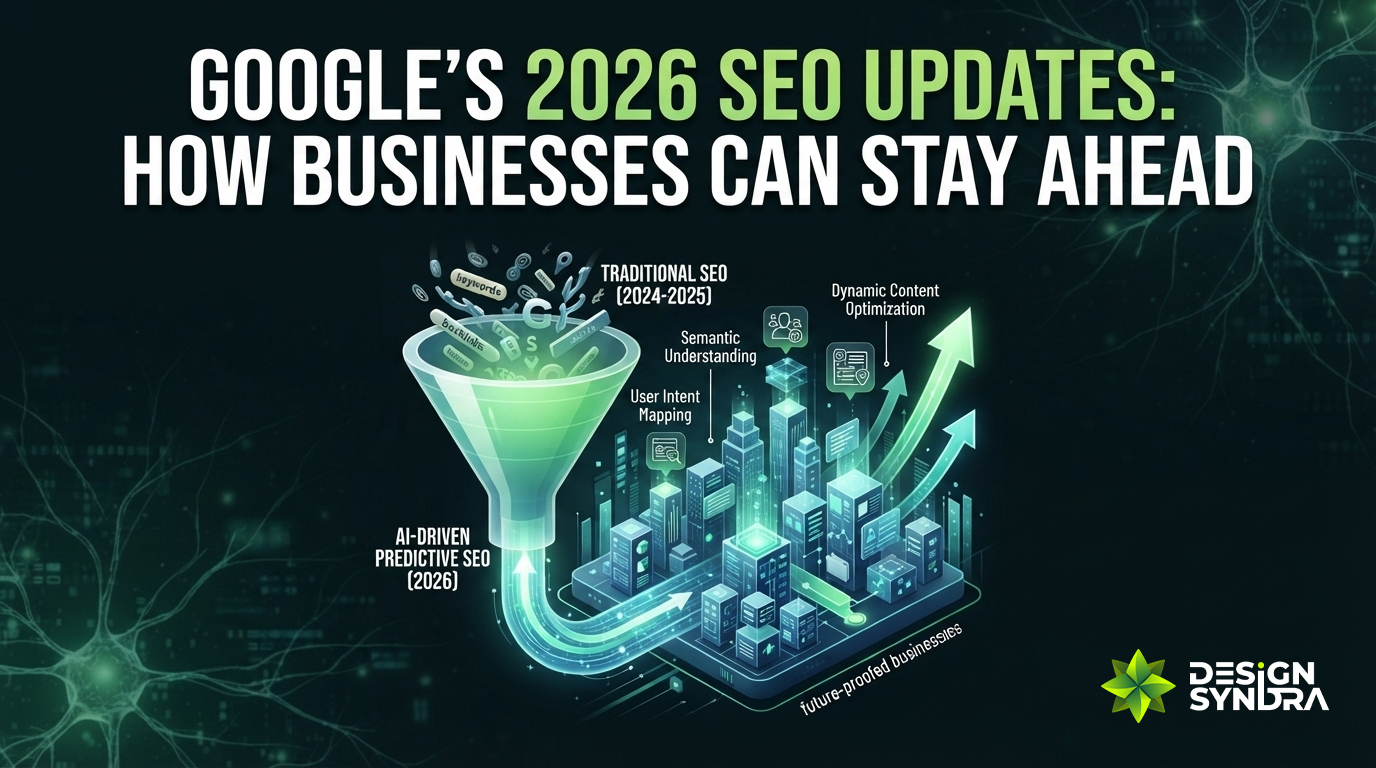
Search is not what it was even eighteen months ago. Between core algorithm updates, spam crackdowns, and the explosive growth of AI Overviews inside the search results page, Google has quietly rebuilt the rules of visibility. If your business is still optimizing the way it did in 2023, you are optimizing for a search engine that no longer exists.
At Design Syndra, we spend our days inside Search Console dashboards, ranking-volatility trackers, and Google Business Profile reports, watching these shifts happen in real time. This guide brings everything together — what changed, why it changed, and exactly what your business needs to do next to stay visible, credible, and profitable in Google Search throughout 2026 and beyond.
We'll walk through Google's core algorithm changes, the rise of AI Overviews, how local SEO and Google Maps rankings now work, the Google Business Profile tactics that actually move the needle, the most common mistakes quietly killing rankings, and how voice and AI search are reshaping the way people find businesses like yours.
A Quick Recap: How Google's 2026 Algorithm Updates Unfolded
Google doesn't run one "big update" a year anymore — it runs a continuous stream of core updates, spam updates, and quality refinements that compound on each other. Understanding the shape of 2026 so far helps explain why your rankings may have moved even if you changed nothing on your site.
The year opened with a confirmed February 2026 Discover core update, followed by one of the most volatile rollouts in recent memory: the March 2026 Core Update, which rolled out from March 27 to April 8, 2026, and drove some of the highest ranking volatility on record, with roughly 80% of top-three results shifting and nearly 1 in 4 top-10 pages falling out of the top 100. Independent trackers echoed the scale of this shift: industry surveys showed over 55% of sites saw a clear hit within two weeks of the rollout, with a fast move toward more focus on who wrote the content, better checks for AI-generated material, and tighter E-E-A-T requirements.
Google didn't stop there. Just five days after the core update completed, a March 2026 spam update expanded enforcement against scaled AI content abuse, expired domain manipulation, and site reputation abuse, also known as parasite SEO. By May, Google had begun rolling out its May 2026 Core Update on May 21, expected to take up to two weeks to fully complete, and industry analysts are already watching for the next major rollout. Based on the established cadence, a core update in June or July 2026 is highly probable.
What's important is that these updates are not punishments. Core updates don't penalize a site — they re-score it. A drop after a core update isn't a manual action; it's Google deciding your page is less of a match for a query than a competitor's page is. That reframe matters enormously for how businesses should respond. You don't need to find something to "delete." You need to build something more relevant, more trustworthy, and more genuinely useful than what currently outranks you.
What Google Is Actually Rewarding in 2026
Across every update this year, three consistent threads keep showing up in Google's own guidance and in the data from major SEO trackers:
Genuine expertise over generic content. Google's Helpful Content system has advanced with deeper AI-driven evaluation, now assessing tone, depth, and user satisfaction signals, and websites that publish comprehensive, well-structured content written for people rather than algorithms are seeing consistent ranking gains.
Technical performance as a baseline, not a bonus. Interaction to Next Paint (INP) has become far more sensitive; while a "good" score is officially under 200 milliseconds, practical analysis in 2026 shows that under high competition it's necessary to keep it below 150 milliseconds. Google has also tightened crawl efficiency expectations: in March 2026, Google revealed that Googlebot imposes a strict 2-megabyte limit when reading an HTML file, while the limit for PDF files is 64MB.
No shortcuts around AI-generated fluff. Google's official guidance shattered the myth that unique AEO or GEO tricks are needed to please AI systems — there's no special need for formats like llms.txt or artificial text chunking. The top priority is "non-commodity content" that carries a unique perspective, original research, and authoritative experience that synthetic text simply cannot replace.
How Google's AI Overviews Are Reshaping SEO in 2026
If one feature defines search in 2026, it's AI Overviews — the AI-generated summary block that now sits above traditional blue links for a huge and growing share of queries. Understanding how it works, and how it changes the economics of a click, is no longer optional for any serious SEO strategy.
The Numbers Behind the Shift
The growth has been fast and, in places, dramatic. Ahrefs data shows AI Overviews appearing on 48% of queries as of March 2026, up from 34.5% in December 2025 — a 58% surge in just three months, reflecting a structural shift in how Google presents information rather than a gradual rollout. Other trackers put the figure even higher for certain markets: AI Overviews now appear in roughly 20% of Google searches on average, reaching up to 37.2% in some countries, while other 2026 industry analyses put the figure at approximately 47–64% of all search queries across desktop and mobile combined, up from roughly 25–30% when the feature first rolled out widely in 2024.
Coverage isn't even across query types. Informational queries trigger AI Overviews around 39.4% of the time versus just 12% for navigational searches, and B2B technology queries see the highest exposure at 70%, while e-commerce queries trigger AI Overviews only about 4% of the time — down from 29% when the feature first launched. If your business sells products directly, that's genuinely good news: transactional search still largely rewards traditional ranking signals.
What This Means for Clicks
The click-through impact is real, but more nuanced than the headlines suggest. AI Overviews cut organic click-through rates by roughly 61% on average, but brands that are actually cited inside the AI Overview earn about 35% more clicks than they otherwise would. There's also encouraging movement in the data: organic CTR on AI-Overview-affected queries recovered from a low of 0.61% in September 2025 to 2.4% by February 2026 — an 85% recovery — though a persistent gap remains between AIO-present queries (2.4% CTR) and AIO-absent queries (3.8% CTR).
Perhaps the most important shift for SEO strategy is this: citation overlap with the organic top-10 has weakened from around 76% in mid-2025 to somewhere between 17% and 54% in early 2026, meaning that ranking #1 no longer guarantees inclusion in the AI Overview. Being cited has become its own discipline, separate from — though still built on top of — classic ranking.
How to Win AI Overview Citations
The pattern across every major 2026 study is consistent. Publishing original research or proprietary data gets cited at 3–5 times the rate of standard blog content, and adding 5–7 current statistics to existing high-traffic pages measurably improves citation odds. Structure matters just as much as substance: the system favors pages that clearly answer questions, define concepts, and explain processes in a structured way, and pages ranking between positions 11 and 20 are frequently referenced in AI summaries — proof that citation and traditional ranking, while related, are not identical.
Depth also compounds. Google's AI Overviews rarely rely on a single source, pulling information from a number of pages instead, and longer overviews tend to draw from a wider range of sources — suggesting that depth and contextual coverage increase the likelihood of being cited. And consistency wins over one-off effort: citation patterns have stabilized in 2026, with sources that demonstrate consistent topical authority earning more stable citation placements over time, rewarding sustained content investment rather than one-off optimization.
The strategic takeaway for any business, including the clients Design Syndra works with, is simple: treat AI Overview visibility as a companion goal to ranking, not a replacement for it. Ranking in the top 10 is still the price of admission, since roughly 92.36% of AI citations come from page-one results — you cannot skip classic SEO and jump straight to "AI optimization." The winning approach blends both.
SEO in the Age of AI: How to Stay Visible on Google in 2026
Zoom out from AI Overviews specifically, and a bigger picture emerges: Google Search itself has quietly split into multiple surfaces that all need attention.
Google now serves three different surfaces for essentially the same query — classic Search, AI Overviews, and Gemini/AI Mode — and each one ranks pages, cites sources, and converts users differently. Treating "SEO" as a single discipline aimed at one set of ranking factors is increasingly out of step with how people actually search.
This is why forward-looking agencies now talk about SEO + GEO (Generative Engine Optimization) as a single combined strategy rather than two separate ones. The winning 2026 playbook blends classic ranking signals with citation-worthy structure: answer capsules, Q&A formatting, statistics with clear sources, a neutral tone, and consistently fresh content.
Several forces are accelerating this shift, and each has a direct implication for how you allocate your marketing time and budget:
Mobile behavior is changing the physical layout of the results page. On mobile devices, AI Overviews occupy substantially more above-the-fold space than on desktop, pushing organic results further down the page — meaning mobile SEO strategy now has to explicitly account for AI Overview displacement.
User trust in AI-generated answers is rising. Research indicates users increasingly trust AI-generated summaries as accurate and sufficient, and the expectation of clicking through to a source page is declining — making the citation itself, not the click, the primary visibility asset for many queries.
The macro trend line points further away from traditional blue links. Gartner projects that by the end of 2026, 25% of organic search traffic will shift to AI chatbots and voice assistants — a structural change affecting virtually every industry.
None of this means traditional SEO is dying — quite the opposite. It means the foundation (technical health, topical authority, E-E-A-T, and genuinely original content) now has to work harder and travel further, feeding both the classic results and the AI layer sitting on top of them. At Design Syndra, we build every content and technical roadmap around this dual-surface reality, because a strategy optimized only for 2023-era Google is now a strategy optimized for a shrinking slice of visibility.
Local SEO in 2026: How to Rank #1 on Google Maps
For any business with a physical location or a defined service area, local search is arguably more important in 2026 than organic blue-link ranking. Local intent is enormous and growing: 46% of all Google searches now carry local intent, and the March 2026 Core Update pushed AI Overviews deeper into local search results as well.
The Three Pillars Google Actually Uses
Despite years of algorithm churn, Google's local ranking system still comes down to the same three fundamentals. Google's own documentation confirms that local rankings are based on three primary factors — relevance, distance, and prominence — and every other local SEO signal feeds into one or more of these three dimensions.
Relevance is the one you control most directly. Google uses your Google Business Profile categories, website content, service descriptions, and associated keywords to assess relevance, and a business with a fully completed profile, accurate categories, and locally optimized website content consistently outranks businesses with incomplete or generic profiles for the same search.
Distance is largely out of your hands, but it's the single heaviest factor. Proximity to the searcher accounts for roughly 55% of local ranking decisions according to the Whitespark 2026 Local Search Ranking Factors survey — which is precisely why the controllable factors below matter so much: they're your best lever against a factor you cannot change.
Prominence reflects your overall reputation and authority across the web, and it compounds slowly but powerfully over time.
The Ranking Weight Breakdown Every Business Should Know
Local SEO research from Whitespark's 2026 survey gives a remarkably clear picture of where to spend your energy: GBP signals lead at 32%, followed by review signals at 20%, on-page SEO at 19%, and link signals at 15%. A parallel breakdown from a separate 2026 dataset adds behavioral and citation signals to the mix: GBP signals (32%), on-page signals (19%), review signals (16%), link signals (15%), behavioral signals (8%), and citation signals (7%).
The message across every study is the same: your Google Business Profile is not a "nice to have" directory listing. It is, functionally, your most powerful local ranking asset — which is exactly why we've dedicated the next section entirely to it.
Why Reviews Matter More Than Almost Anything Else
Reviews aren't just a trust signal for customers — they're one of the strongest ranking levers you can pull yourself. 87% of consumers read online reviews for local businesses in 2026, making reviews the most influential local ranking signal and the primary trust factor for new customers. Consistency beats one-time bursts: review velocity (getting new reviews consistently) and response rate matter more than raw count, and businesses that respond to 80% or more of their reviews see a measurable ranking boost. There's also a credible momentum effect for newer profiles: there appears to be early visibility momentum once a new profile reaches around ten reviews, though long-term success still depends on ongoing, steady growth rather than a single push.
AI Search Is Now Part of Local Visibility, Too
Local discovery is no longer confined to Google Maps. For the first time in Whitespark's survey history, AI search visibility appeared as a formal local SEO ranking category in 2026, and ChatGPT usage for local business recommendations grew from 6% to 45% in a single year according to BrightLocal's 2026 data. The good news is that you don't need a separate playbook for this: AI visibility depends on the same signals that drive traditional local SEO — but weighted toward structured, consistently referenced business data, since AI systems favor businesses that look real, active, and consistently referenced across multiple sources.
Google Business Profile Hacks Every Local Service Needs in 2026
Given that GBP signals carry the single largest weight in local ranking, it's worth breaking down exactly what "optimizing your profile" means in practice this year — not vague advice, but the specific moves that are actually driving results.
Treat your GBP like a free storefront, because Google does. Google continues to expand GBP features, effectively making it a free storefront, and businesses that optimize their profiles are capturing disproportionate local traffic — GBP actions such as calls, direction requests, website visits, and booking actions surged 41% year-over-year between 2025 and 2026.
Get your primary category exactly right, and don't try to game your business name. A complete profile with accurate categories, active posts, and real photos signals trust to Google faster than any other factor, and keyword stuffing in your business name now triggers GBP Policy Enforcement suspensions. This used to be a common (if risky) local SEO trick; in 2026, it's simply a fast way to lose your listing.
Post and photograph consistently, not sporadically. Google prefers businesses that actively maintain their profiles — regular posts demonstrate that a business is active and provide users with fresh information, and businesses with updated images often receive more profile interactions. The data backs a specific cadence too: profiles adding photos biweekly outperform quarterly updaters by roughly 30% in engagement metrics.
Bring E-E-A-T into your profile, not just your website. Google's focus on E-E-A-T — experience, expertise, authoritativeness, and trustworthiness — has reached local search in a meaningful way, and businesses that show real-world proof of their work through photos, reviews, case studies, and detailed service descriptions are getting rewarded. It's also worth remembering that your GBP now feeds directly into AI-generated answers: Google's AI Overviews pull information directly from your profile and website, so incomplete or inconsistent information means you may simply be passed over.
Build unconventional but genuine citation signals. Beyond the obvious directories, newer signal sources are gaining real weight. Community organization links from nonprofits, schools, and local event pages build topical and geographic relevance simultaneously, Reddit mentions in local subreddits function as unstructured citations that Google reads as community trust signals, and Quora answers targeting local intent queries feed user-generated content into your broader authority profile.
Keep the fundamentals boring and consistent. None of the above replaces the basics. Creating location-specific pages, using local keywords naturally, improving page speed, ensuring mobile responsiveness, adding clear contact information, and publishing genuinely helpful local content all remain part of a complete local SEO foundation. As one 2026 analysis put it plainly: Google Business Profile ranking factors haven't fundamentally changed — relevance, distance, and prominence still rule. What's changed is the competition; hacks fade quickly, but structure compounds.
At Design Syndra, this is exactly the layered approach we build into every local campaign: complete profile fundamentals first, then a steady drumbeat of reviews, photos, and posts, then the less obvious authority signals that separate a business sitting in position four from one sitting in the map pack's top three.
5 SEO Mistakes Killing Your Google Rankings in 2026
Even strong businesses are losing visibility this year — often not because of some dramatic algorithm "penalty," but because of a handful of avoidable mistakes that compound quietly over time.
1. Ignoring Technical Performance Until It's Too Late
Speed and interactivity are no longer background metrics. While a "good" Interaction to Next Paint score is officially under 200 milliseconds, practical 2026 analysis shows that under real competitive pressure, sites need to stay below 150 milliseconds to hold their ground. Pair that with the fact that Googlebot enforces a strict 2-megabyte limit when reading an HTML file, meaning everything placed beyond that limit is effectively invisible to the crawler, and it's easy to see how bloated, script-heavy pages quietly sabotage their own rankings.
2. Publishing "Commodity" Content That Adds Nothing New
Google's own guidance has made clear that the top priority is "non-commodity content" — material that carries a unique perspective, original research, and authoritative experience that synthetic, AI-generated text simply cannot replace. If your blog reads like a rephrased version of the top five existing results, you're competing for scraps, not visibility.
3. Treating Mobile as an Afterthought
Mobile-first indexing has been amplified in the 2026 updates, and if a website isn't properly optimized for mobile, a dip in rankings should be expected. This compounds with the AI Overview shift noted earlier — mobile screens now have even less room for organic results once AI content and local packs are accounted for, so a slow or clunky mobile experience costs you twice as much.
4. Chasing AI Overviews While Ignoring Classic Ranking
It's tempting to obsess over "getting cited" and forget the fundamentals that make citation possible in the first place. But 92.36% of AI citations still come from page-one organic results, so neglecting core on-page SEO, backlinks, and site structure in favor of AI-specific tricks is a losing trade. Optimize the foundation first; layer citation-worthy structure on top of it.
5. Letting Reviews and Local Signals Go Stale
A polished website means little if your local presence looks abandoned. Businesses that respond to 80% or more of their reviews see a measurable ranking boost, yet many businesses let reviews pile up unanswered for months. Combined with infrequent GBP posts and outdated photos, this signals inactivity to Google at exactly the moment prominence and trust matter most.
Avoiding these five mistakes won't guarantee a #1 ranking on its own, but it removes the self-inflicted wounds that make every other strategy in this article harder to execute.
Voice Search and Google AI: The Future of SEO in 2026
Voice has quietly become one of the largest and least-optimized channels in search. The scale is genuinely striking: 8.4 billion voice assistants are now active worldwide, and every smartphone, smart speaker, vehicle infotainment system, and wearable device contributes to a voice-first ecosystem that now processes over 10 billion queries per day.
The Platform Shift Nobody Can Ignore
The underlying technology is being rebuilt in real time. Google has been phasing out the classic Google Assistant in favor of Gemini, which is taking over as the company's main voice engine, and adoption is already massive: Gemini has surpassed 750 million monthly users. This isn't happening in isolation — Amazon has shipped Alexa Plus and Apple has been quietly rewriting Siri under the same large-language-model paradigm, meaning the assistant on a user's phone today will behave very differently within the next 24 months.
Why Voice and Local SEO Are Now the Same Discipline
If your business serves a specific geographic area, voice search is really just local search spoken aloud. Around 76% of voice queries are local, and optimizing your Google Business Profile, keeping NAP information consistent across the web, using neighborhood-level language in your copy, and earning a steady stream of recent reviews are the highest-impact moves for voice — and they happen to be the same highest-impact moves for traditional local SEO.
What Actually Gets Read Aloud
Understanding where voice answers come from tells you exactly how to structure your content. Roughly 50% of voice search results rely on a featured snippet to provide the answer, and voice assistants often read that featured snippet content aloud — so structuring content with concise answers, lists, and Q&A formatting is one of the most direct ways to capture voice queries. Content depth matters here too, more than you might expect: the average word count of pages that rank for voice search is approximately 2,312 words, and technical basics still apply, since more than 70% of websites ranking in Google Voice search results are HTTPS-secured.
Schema markup is another lever worth using deliberately: Speakable schema indicates to search engines which sections of content are suitable for voice reading, and Google uses it to select passages to read aloud via its assistants — significantly increasing the chances of being cited.
The Opportunity Gap
Here's the part that should catch every business owner's attention: almost nobody is doing this well yet. Only 13% of marketers report that they actively optimize for voice search, despite the fact that 52% of people use voice search daily or almost daily and around 90% of users say voice search feels easier than typing, with 89% considering it more convenient and 87% saying it saves them time. For businesses willing to invest now — structuring content for direct answers, tightening local NAP consistency, and adding Speakable schema — this is one of the clearest visibility gaps left in modern SEO.
How to Boost Your Google Search Visibility in 2026
Pulling every thread in this article together, here's the practical playbook Design Syndra recommends for businesses that want durable visibility — not a temporary bump — heading into the rest of 2026.
Build content around genuine expertise, not keyword coverage. Every signal points the same direction: original research, first-hand experience, and clearly demonstrated authorship outperform generic, broad-coverage content. This satisfies E-E-A-T, resists core update volatility, and is precisely the kind of material AI Overviews prefer to cite.
Fix technical health before chasing new tactics. Sub-150ms INP, mobile-first design, clean crawlability, and HTTPS aren't glamorous, but they're now baseline requirements — not competitive advantages — and slipping on them silently caps everything else you do.
Treat your Google Business Profile as a primary marketing channel. With GBP signals carrying roughly a third of local ranking weight, a complete, actively maintained, review-rich profile is one of the highest-ROI investments available to any local or service-area business.
Structure content for both humans and AI citation. Clear headings, direct answers near the top of sections, supporting statistics with sources, and genuinely useful depth all increase your odds of appearing inside AI Overviews and voice answers — without sacrificing readability for the humans who do click through.
Don't neglect the "boring" trust signals. Consistent NAP data, a steady stream of reviews with real responses, fresh photos, and regular GBP posts all compound quietly over months. None of these are exciting, but together they build the prominence that Google — and increasingly, its AI systems — reward most.
Monitor continuously, not reactively. With updates now landing every few months and AI Overview coverage expanding by the week, a "set it and forget it" SEO strategy is no longer viable. Regular audits of Search Console, ranking volatility, and AI citation status should be a standing part of your marketing routine, not an emergency response after traffic drops.
Final Thoughts
Google's 2026 algorithm updates haven't broken SEO — they've raised the bar for what "good" actually looks like. The businesses thriving right now aren't the ones chasing every new AI trick; they're the ones treating E-E-A-T, technical performance, local trust signals, and genuinely original content as the non-negotiable foundation they've always been, then layering AI and voice visibility on top of that foundation rather than instead of it.
That's the exact strategy Design Syndra builds for every client — a search presence engineered for how people, and increasingly AI systems, actually find and evaluate businesses in 2026. If your rankings have moved this year and you're not sure why, or you simply want a search strategy built for where Google is headed next, our team is ready to help you turn this update into an opportunity instead of a setback.